Are you looking for a pain specialist? Find a pain centre near you
Skip to main content
A lady walking her dog

The Intracept Procedure

Chronic low back pain (CLBP) steals so much of life. Now there’s a way to get back to living. The Intracept Procedure can provide you with proven and long-lasting relief of CLBP.

What is the Intracept Procedure?

The Intracept Procedure is a one-time, minimally invasive, outpatient procedure for people with vertebrogenic low back pain. The procedure uses heat to target a specific nerve within the vertebrae called the basivertebral nerve (BVN).

The procedure is drug free and implant free — making it less invasive than other treatment options.

Is the Intracept Procedure right for me?

Patients who find relief from the Intracept Procedure often describe pain in the middle of their lower back is often made worse by:1

Bending forward

Leaning forward places additional pressure on the lower spine, intensifying your discomfort.

Person bending forward to pet a cat.

Lifting objects

Improperly lifting strains the back muscles and spine, which can worsen CLBP over time.

Person carrying a box of bottles with a recycling symbol on it.

Physical activity

Engaging in physical activities can cause pain.

Person walking a dog on a leash.

Prolonged sitting

Sitting for extended periods aggravates your CLBP symptoms.

Person sitting on a chair, holding a fishing rod over water ripples.
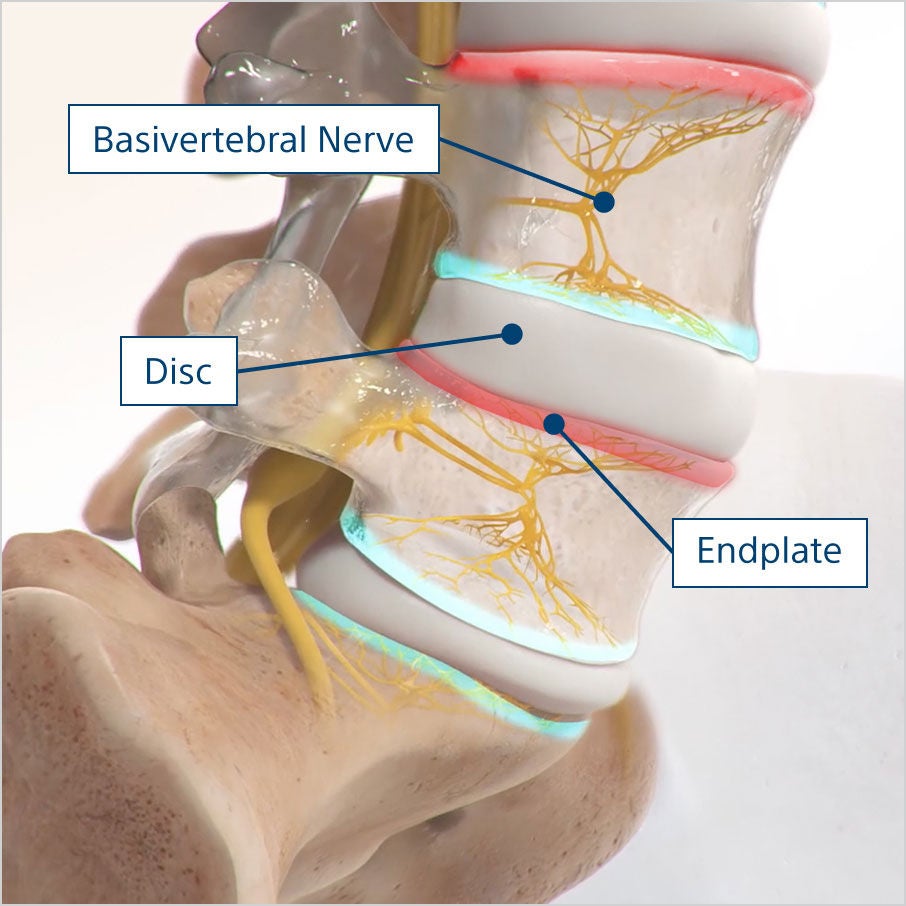
Detailed view of spinal anatomy showing the basivertebral nerve, disc, and endplate.

What is vertebrogenic pain?

1 in 6 people with chronic low back pain have a specific type of pain called vertebrogenic pain.

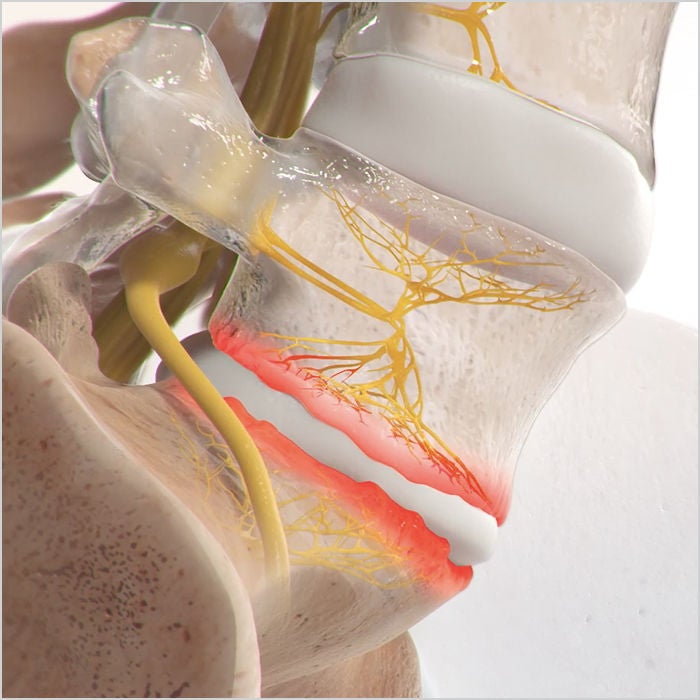
Vertebrogenic pain is back pain that stems from the bones in your spine, called vertebrae. Inside the vertebral bone is a nerve called the basivertebral nerve. If certain parts of your vertebrae become damaged, it can irritate this nerve and cause pain.

Proven relief of vertebrogenic pain

Diagram representing Less pain

Less pain

Nearly 66% of patients had a 50% or greater reduction in pain after 5 years.2

Diagram representing More activity

More activity

Nearly 70% of patients were able to resume the activity level enjoyed prior to the onset of low back pain.2

Diagram representing Proven safe

Proven safe

Less than 0.3% rate of procedure-related complications in clinical trials.3

Diagram representing 1 time procedure

1-time procedure

69% of patients avoided any additional low back spine treatments for 5 years after the procedure.4

How does the Intracept Procedure work?

The Intracept Procedure is a safe, minimally invasive procedure that is proven to provide long-lasting vertebrogenic pain relief.5

Your pain specialist may recommend the Intracept Procedure when nonsurgical options like medications, injections, or physical therapy aren’t enough to treat your CLBP.  

A healthcare provider smiles while talking to a patient in a hospital bed.

Before

The Intracept Procedure is performed in an outpatient surgery center. You will typically receive general anesthesia before the procedure for your comfort, so you must bring someone you trust to drive you home afterwards.

Follow any directions your pain specialist gives you related to the medication or supplements you take in the days leading up to your procedure.

A healthcare worker in protective gear stands by a patient lying on a medical table.

During the Intracept Procedure

Unlike surgeries, the Intracept Procedure is implant-free. During the procedure, your pain doctor will create a small incision in your back to access your basivertebral nerve (BVN).

A close-up of a spinal section showing nerves, disc, and highlighted inflammation.

Targeting the nerve

The doctor will use imaging and special tools to access the BVN, which sends pain signals from the damage in your lower back to your brain.

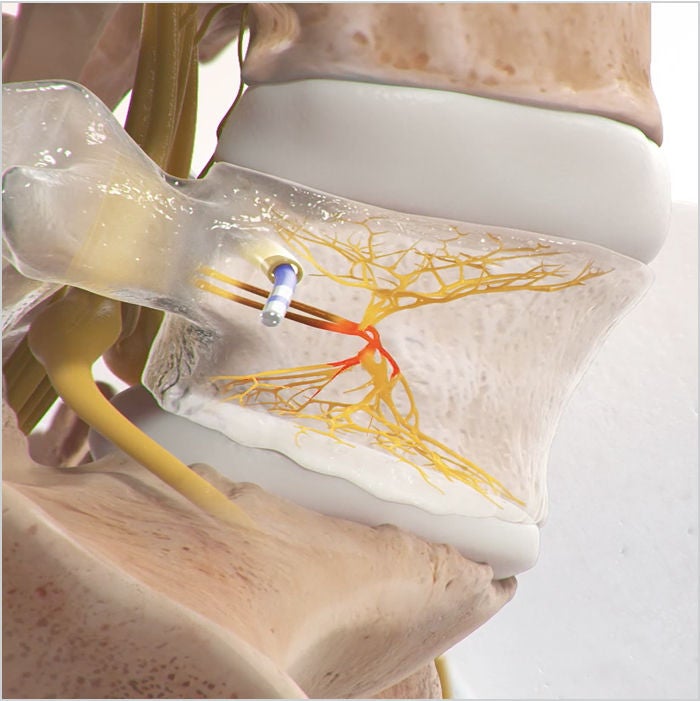
Detailed view of a spinal disc with a tool heating up the impacted nerve root.

Heating the nerve

Once the BVN has been successfully reached, radio frequency energy will be used to heat the nerve to stop it from sending pain signals.

A smiling woman lifts a laughing child sideways in front of a green couch.

After

The whole procedure usually takes between 60 and 90 minutes to complete. You will be able to go home once sedation has worn off.  Your doctor may recommend some precautions to take, but after a brief recovery period, you should be able to resume normal activities.

Most people start to feel pain relief within two weeks to three months after the Intracept Procedure.6-8

Get back what pain has stolen from you

CLBP can take so much from you: That spontaneous road trip, that special hug, that long-lost workout routine. Let’s bring these moments back with the Intracept Procedure, the only procedure clinically proven to provide relief of vertebrogenic pain.

Vertebrogenic pain and the Intracept Procedure

Understand the common symptoms for vertebrogenic pain and how the Intracept Procedure can get you back to the life you’ve been missing. 

References  

  1. Koreckij T, Kreiner S, Khalil JG, Smuck M, Markman J, Garfin S. Prospective, randomized, multicenter study of intraosseous basivertebral nerve ablation for the treatment of chronic low back pain: 24-month treatment arm results. NASSJ. Published online October 26, 2021. DOI: https://doi.org/10.1016/j.xnsj.2021.100089 
  2. Khalil, J., et al. Intraosseous basivertebral nerve ablation: 5-year outcomes from three long-term follow-up studies. Interventional Pain Medicine, Volume 3, Issue 4, 2024,100529, ISSN 2772-5944, https://doi.org/10.1016/j.inpm.2024.100529.doi.org/10.1007/s00586-020-06448-x 
  3. Data on file. 
  4. Khalil JG, Truumees E, Macadaeg K, et al. Intraosseous basivertebral nerve ablation: A 5-year pooled analysis from three prospective clinical trials. PubMed. 2024. 
  5. Fischgrund J, Rhyne A, Macadaeg K, et al. Long-term outcomes following intraosseous basivertebral nerve ablation for the treatment of chronic low back pain: 5-year treatment arm results from a prospective randomized double-blind sham-controlled multi-center study. Eur Spine J. 2020;29(8):1925-34. http://doi.org/10.1007/s00586-020-06448-x 
  6. Fischgrund JS, Rhyne A, Franke J, et al. Intraosseous basivertebral nerve ablation for the treatment of chronic low back pain: a prospective randomized double-blind sham-controlled multi-center study. Eur Spine J. 2018;27(5):1146-56. doi:10.1007/s00586-018-5496-1 
  7. Smuck M, Khalil JG, Barrett K, Hirsch JA, Kreiner S, Koreckij T, et al. A prospective, randomized, multi-center study of intraosseous basivertebral nerve ablation for the treatment of chronic low back pain: 12-month results. Reg Anesth Pain Med. 2021;rapm-2020-102259. doi:10.1136/rapm-2020-102259 
  8. Macadaeg, E. Truumees, B. Boody, E. Pena, J. Arbuckle II, J. Gentile, R. Funk, D. Singh, S. Vinayek, A prospective, single arm study of intraosseous basivertebral nerve ablation for the treatment of chronic low back pain: 12-month results, North American Spine Society Journal (NASSJ) (2020), doi.org/10.1016/j.xnsj.2020.100030  

This material is for informational purposes only and not meant for medical diagnosis. This information does not constitute medical or legal advice, and Boston Scientific makes no representation regarding the medical benefits included in this information. Boston Scientific strongly recommends that you consult with your physician on all matters pertaining to your health.

CAUTION: The law restricts these devices to sale by or on the order of a physician. Indications, contraindications, warnings, and instructions for use can be found in the product labelling supplied with each device or at www.IFU-BSCI.com. Products shown for INFORMATION purposes only and may not be approved or for sale in certain countries. This material not intended for use in France.